
The short answer
What is tested is whether circuit integrity holds in a specified test, and that is not covered by the two fire clauses of GB/T 7251.6-2015. Clause 9.101, resistance to flame propagation, has its criterion in Clause 10.101; Clause 9.102, fire resistance in building penetrations, points to ISO 834-1. Both govern whether fire runs along the busway or passes through a wall.
The standard itself puts "applications requiring specific performance under fire conditions, for example circuit integrity for a specified time" in Clause 7.2, item dd), as a special service condition — the general rules set no verification method for it. JB/T 10327-2011 turns it into a product category, defined as maintaining circuit integrity for a specified time; its method points to Clause 4.3 of XF/T 537-2005: the spray test and the fire test must both pass, and a 0.25 A loop is only the condition of the 4.3.2 fire test. "Fire-barrier" and "fire-resistant" are two categories, not two degrees of one property.
What do the two fire clauses in GB/T 7251.6 cover?
Clause 5.6 adds two characteristics: bb) resistance to flame propagation, if applicable (see 9.101); cc) fire resistance in building penetrations, if applicable (see 9.102). Neither is "supply power during a fire".
| 9.101 Resistance to flame propagation | 9.102 Fire resistance in building penetrations | |
|---|---|---|
| Object | Non-flame-propagating busway system | Fire-barrier busway unit |
| Performance requirement | Clause 9.101 | Clause 9.102 |
| Design verification | Clause 10.101 (apparatus per GB/T 18380.31) | Clause 10.102 (criterion per ISO 834-1) |
| Duration | 40 min of flame application | 60, 90, 120, 180 or 240 min |
| Criterion | No combustion; charred portion not above 2.5 m from the burner base (small parts whose burning does not affect channel integrity may be disregarded) | No flame propagation for the specified time |
| Energised during test | No | No |
Three things must not be conflated: 9.101 is the performance requirement, 10.101 its design verification, GB/T 18380.31 only the apparatus. Writing the criterion as "char height per GB/T 18380.31" misattributes it: char height is 10.101's criterion.
Clause 10.102 spans two printed pages. Page 18 requires thermocouples on the unexposed face to record the enclosure surface temperature. Only the first sentence of page 19 gives "the performance criteria are given in ISO 834-1:1999", and the next sentence adds that a test with a test wall is valid for wall penetrations. Read page 18 alone and the surface temperature looks like a mere record — the criterion is on the next page.
How does the standard itself treat "circuit integrity"?
Clause 7.2 lists special service conditions. After items aa) to cc), item dd) reads: applications requiring specific performance under fire conditions, for example circuit integrity for a specified time.
Two things follow: the standard acknowledges the need, and classifies it as a special service condition — the general rules set no verification method, so meeting it needs agreement between user and manufacturer, or a dedicated product standard.
That division is the standard's own: 9.101 and 9.102 sit in performance requirements; circuit integrity sits in special service conditions.
So what does "fire-resistant" test?
Under JB/T 10327-2011, the criterion is maintaining circuit integrity.
JB/T 10327-2011 is a machinery-industry standard, issued 2011-12-20, effective 2012-04-01, replacing JB/T 10327-2002. It separates two easily confused categories:
- 3.1 busway fire-barrier unit: a busway unit that, under fire conditions, prevents flame propagation for a specified time;
- 3.2 fire-resistant busway system: a busway unit that, under fire conditions, maintains circuit integrity for a specified time.
The criteria sit in Clause 6.1.3.14.2 in two groups: b) to e) means the fire-barrier performance fails; a) or b) means the fire-resistant performance fails. Items: a) loss of circuit integrity; b) obvious bending deformation; c) flame on the unexposed face for more than 10 s; d) mean temperature 140 °C above the initial mean, or any point 180 °C above its initial value; e) breakdown or flashover after the 5.5.6 test.
a) belongs only to fire-resistant, c) to e) only to fire-barrier, and b) to both. A product that deforms obviously fails both; fire passing through, excess temperature and breakdown judge fire-barrier only.
Clause 6.1.3.14.1.2 points the test method at Clause 4.3 of GA/T 537-2005, now numbered XF/T 537-2005. Compliance under 4.3 has two parts: the water-spray test in 4.3.1 and the fire test in 4.3.2 must both pass before fire-resistant performance is judged compliant.
Clause 4.3.2 is the circuit-integrity verification: the specimen is raised to rated voltage, the loop current is set to 0.25 A, flame is applied for not less than 30 min, the circuit stays energised for 15 min after the flame stops, and the criterion is "voltage maintained, conductors unbroken". That is integrity under the specified test conditions, not supply capacity at rated load. The specimen is a straight unit, at least 4 m exposed and one joint, supported at both ends and sealed at the furnace ends — the furnace arrangement, not site sealing.
Three layers must be kept apart: ① full fire-resistance compliance = spray plus fire test both passed; ② circuit verification = a 0.25 A loop stayed closed; ③ actual load-carrying = supply at rated current in a fire. Layer ③ has no criterion in these two documents. 0.25 A against a 1,600 A nameplate is 1:6,400 — that ratio only shows how far layer ② sits from layer ③.
XF/T 537-2005 splits flame retardance, fire-barrier and fire resistance into three regimes, and certification follows the same three tiers.
Why are the two terms confused?
Because the fire-barrier path is complete inside GB/T 7251.6, and the fire-resistant path is not inside it at all.
Read GB/T 7251.6 and 9.102 looks the part: time steps, an ISO 834-1 criterion, the term "fire barrier". By the JB/T 10327 definitions it verifies a fire-barrier unit; fire-resistant status needs Clause 6.1.3.14.1.2 separately.
The consequence: a unit that passed 9.102 for 120 min has a report proving fire did not pass through; it does not prove conductors stayed energised. On a fire-pump circuit, that means carrying a supply duty with a fire-blocking certificate.
At 180 minutes the furnace is hotter than molten copper — what does that show?
That furnace temperature and specimen temperature are two different quantities, and neither can be extrapolated from the other.
With T = 345·log₁₀(8t+1) + 20 from ISO 834-1:
| Time | Nominal furnace temperature |
|---|---|
| 60 min | 945.3 °C |
| 120 min | 1,049.0 °C |
| 180 min | 1,109.7 °C |
| 240 min | 1,152.8 °C |
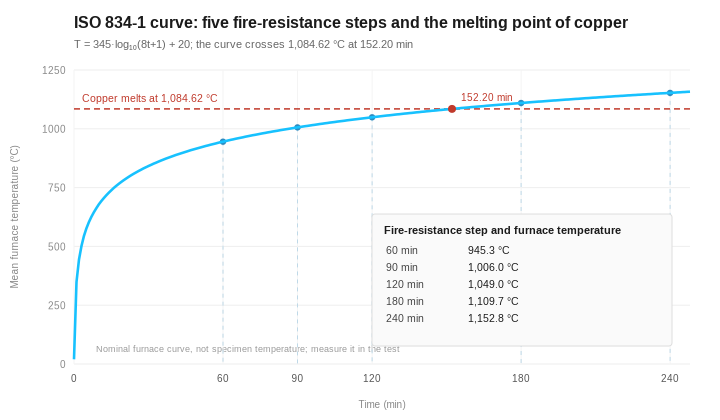
Taking the melting point of copper as 1,084.62 °C (the NIST fixed point), the curve crosses it at minute 152.20: the 120-minute step sits 35.6 K below, the 180-minute step 25.1 K above, and the 240-minute step 68.2 K above.
What can be said is narrow: on this nominal curve, the 180-minute value is already above the melting point of copper. It does not follow that the busbar reaches that temperature or melts, nor which layer keeps the assembly intact — that depends on the insulation build and the measuring points. Taking a nominal furnace temperature for a specimen temperature is a common overreach.
Five time steps: which one applies?
The product standard offers five, the building code seven, and a second mandatory code adds one more. The three do not line up.
Clause 9.102 of GB/T 7251.6-2015 reads: "if applicable, the preferred times are 60 min, 90 min, 120 min, 180 min or 240 min." It does not say which applies where.
On the building side, Table 5.1.2 of GB 50016-2014 (2018 edition) gives fire resistance by element: fire walls 3.00 h; load-bearing walls 3.00 to 0.50 h; floors 1.50/1.00/0.50 h; corridor partitions 1.00/1.00/0.50/0.25 h; room partitions 0.75/0.50/0.50/0.25 h. In minutes that is 15, 30, 45, 60, 90, 120 and 180 — civil-building comparison values, not product-standard steps. Clause 6.1.3 of GB 55037-2022 then requires fire walls in Class A and B industrial buildings and in Class A, B and C warehouses to be not less than 4.00 h (240 min).
Both lists contain 60, 90, 120 and 180; only the product standard has 240 (matching case in GB 55037); only the building table has 15, 30 and 45.
But matching minutes is not coverage. Clause 6.3.4 of GB 55037-2022 requires voids where routes pass through fire walls, partitions, shaft walls, movement joints and floors to be sealed, and the fire-stop component's performance to be no lower than that of the compartment it penetrates. The clause lands on the installed fire-stop and the compartment it separates, not the product test.
A wall or floor penetration therefore has four things to check: the wall or floor, the penetrating item, the opening, and the sealing method. All four must match the construction covered by the report; the unit's minutes are only one input.
One layer belongs to the product standard, not to sealing: Clause 10.102 has its own requirements for the test wall and for wall-penetration validity — page 19, second sentence: a test with a test wall is valid for wall penetrations. It judges the product in a given construction, not the installed seal.
A 120-minute result therefore proves that in the construction the report describes, fire did not pass through for 120 minutes — limited to that construction and project.
Are the referenced test methods still current?
Both have moved, for different reasons.
GB/T 18380.31-2008 has been withdrawn. Clause 10.101 states that the test "shall be carried out in accordance with GB/T 18380.31-2008", and that edition was wholly replaced on 2022-10-01 by GB/T 18380.31-2022; the two editions also adopt different IEC sources (60332-3-10:2000 and 2018).
ISO 834-1:1999 has been withdrawn internationally. ISO published ISO 834-1:2025 on 2025-05-30, and the 1999 edition is now marked Withdrawn. That does not re-version the Chinese standard automatically: Clause 2 of GB/T 7251.6-2015 cites ISO 834-1:1999 by date, so only that edition applies; the Chinese counterpart, GB/T 9978.1-2008, remains current, with a review decision of continue-valid dated 2025-05-30.
The two must be kept apart: an international withdrawal is one thing, the edition a report rests on another; a report has to say which.
Open questions
Supply capacity at rated current in a fire has no criterion in the two documents discussed here. The 0.25 A loop in Clause 4.3.2 verifies continuity only (layer ②). For layer ③ — carrying 1,600 A in a fire — how conductor temperature, insulation resistance and joint contact resistance behave, neither document has a test.
Whether the 9.102 and JB/T 10327 tests can substitute for each other is not stated in these two documents. Specimen arrangement, criteria sets and energisation differ; the text gives no rule for choosing.
References
All links accessed 2026-11-23.
- GB/T 7251.6-2015, Busbar trunking systems (busways) — standard information page (current; effective 2016-06-01). https://www.chinesestandard.net/PDF.aspx/GBT7251.6-2015
- IEC 61439-6:2012, Low-voltage switchgear and controlgear assemblies — Part 6: Busbar trunking systems (busways) — public full text (Clauses 9.101/9.102 and 10.101/10.102 share their origin with GB/T 7251.6-2015). https://law.resource.org/pub/us/cfr/ibr/inc/iec/iec.61439-6.2012.pdf
- JB/T 10327-2011, Fire-resistant busbar trunking systems (fire-resistant busways) — standard detail page (current; effective 2012-04-01; replaces the 2002 edition; Clauses 3.1/3.2 and 6.1.3.14 quoted here were checked against public transcriptions, official copy not obtained). https://std.samr.gov.cn/hb/search/stdHBDetailed?id=8B1827F1B88CBB19E05397BE0A0AB44A
- XF/T 537-2005, Test methods for flame retardance, fire-barrier and fire-resistance performance of busbar trunking systems — Clause 4.3 as published in a public transcription (water-spray and fire tests both required; 0.25 A loop; flame for not less than 30 min; 15 min energised afterwards; transcribed text, official copy not obtained). https://gf.cabr-fire.com/article-24772.htm
- GB 50016-2014 (2018 edition), Table 5.1.2 fire-resistance values (three-source consistent transcription). https://zrzyhgh.wuhan.gov.cn/gsggzx/zxwj/202606/P020260618585307617835.pdf
- GB 55037-2022, General code for fire protection of buildings — public full-text PDF (Clause 6.1.3: fire walls 4.00 h; Clause 6.3.4: fire-stop performance not lower than the compartment). https://js.119.gov.cn/group1/M00/01/D6/rBPe7Wi5YSWATAAkABU9IFBisPA109.pdf
- ISO 834-1:2025, Fire-resistance tests — Elements of building construction — Part 1: General requirements — edition page (published 2025-05-30; the 1999 edition is withdrawn). https://www.iso.org/standard/83943.html
- NIST. Standard Reference Materials: Radiance Temperature Calibrations (NIST SP 250-43), Section 2.2: copper freezing point 1,084.62 °C. https://nvlpubs.nist.gov/nistpubs/Legacy/SP/nistspecialpublication250-43.pdf
- CQC17-462158-2023, Busway fire-performance certification rules, Tables 5-1/5-2 (cross-check). https://www.cqc.com.cn/www/upload/file/2026-01/col1008/1767766384924.pdf
This article is an industry observation and does not constitute procurement advice. | Updated 2026-11