
The short answer
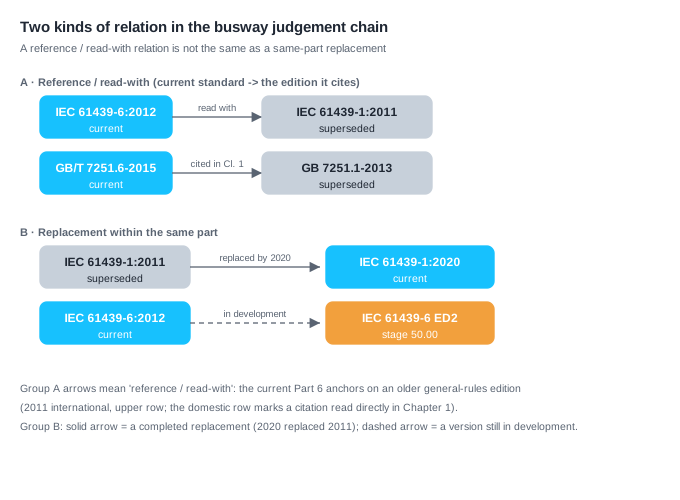
The obtained text of the current busway standard GB/T 7251.6-2015 cites the general rules with a year, and the edition it cites is GB 7251.1-2013 — which was fully replaced by GB/T 7251.1-2023 on 2024-03-01. The international side has the same shape: the foreword of IEC 61439-6:2012 states that it is to be read in conjunction with the 2011 general rules, and that edition was cancelled and replaced by the 2020 third edition.
Be clear about how far that goes: it answers "what the citations we obtained actually say" — a checkable textual fact. It does not mean every busway report must be judged against the 2013 edition. A particular report also turns on certification rules, change notices, contracts and technical agreements, and this article does not rule on any particular report's applicable edition.
Which general rules does the current standard cite?
A busway's product standard is Part 6; it does not carry all the technical requirements itself but references the general rules (Part 1). So "which edition governs" is first a textual question: which edition of Part 1 does Part 6 cite?
First, how deep the reading went. In the public preview, what was obtained and read word for word here is the foreword, Chapter 1, and part of Chapter 10 of GB/T 7251.6-2015; Chapter 2 (normative references) appears only in the contents — its text was not obtained. So the answer comes in two layers:
- Read directly: in Chapter 1 the document cites the general rules with a year — the manufacture/assembly paragraph points to 3.10.1 and 3.10.2 of GB 7251.1-2013; and Chapter 10 (10.2.101.4) carries another dated citation (the dielectric test "according to 10.9.2 of GB 7251.1-2013"). Both land on the 2013 edition.
- Inferred from those citations and the contents (not read directly): that Part 6 uses a citation with a year (a dated reference) for Part 1, i.e. only the edition named applies, and that Chapter 2's rule matches. This layer is an inference; Chapter 2's text was not read word for word.
⇒ On the text obtained, the answer is the 2013 edition. That depends only on how those citations are written, not on the reader's preference. Whether every remaining clause of Part 6 is a dated citation, this article cannot assert — it does not have the full text.
Why does a superseded edition still stand in a current standard?
Because a standard text is not rewritten automatically when the document it cites moves on.
GB 7251.1 was fully replaced on 2024-03-01, when the 2023 edition took over from the 2013 edition; but GB/T 7251.6-2015 was issued in 2015 and has not been re-issued since — its reference clause still names the edition of that year and nothing rewrites it after the fact. As long as Part 6 itself is not re-issued, its footnote reading "GB 7251.1-2013" stays there.
Two clocks are running: the general rules have changed twice already, while the part-standard still sits on its own edition. A judgement that "anchors on an older edition" is a statement about a reference relationship, not a statement that the judgement itself has lapsed.
Is the international structure the same?
It is the same, and in the same form.
IEC 61439-6:2012 is the international busway standard; GB/T 7251.6-2015 is its identical adoption. Its foreword settles it with two sentences: one says it is aligned "on the second edition of IEC 61439-1 (2011)" regarding structure and technical content; the other says the publication "is to be read in conjunction with IEC 61439-1:2011". So Part 6 anchors on the 2011 edition.
And IEC 61439-1:2011 met the same fate as the domestic 2013 edition — the 2020 third edition explicitly cancels and replaces the 2011 second edition.
⇒ Both sides show one structure: a current part-standard → a dated reference → a superseded edition of the general rules. They differ only in version numbers. Note how to read the figure: the axis lists each standard's own versions, and the arrows show only a reference / read-with relationship and a same-part replacement relationship — not "Part 1 evolving into Part 6".
Where has the next edition got to?
The international and domestic tracks are two different timelines and must be read separately.
International (IEC): the second edition (ED2) of IEC 61439-6 sits at a defined point in the approval process — the final text is received / the FDIS is registered for formal approval (IEC stage 50.00), dated 2026-05-19. Some national bodies' project pages give the next node as 2026-08-11. Not yet published.
Domestic: it is now on a revision plan, 20264988-T-604 — issued 2026-09-30, a six-month project period, currently at the drafting stage — planned for identical adoption of IEC 61439-6:2026 and to fully replace GB/T 7251.6-2015.
⇒ Keep two things apart: in development / drafting ≠ published. ED2 is not yet published and the domestic revision has just entered drafting; until they are formally published, the textual reference relationship remains the 2015 edition citing the 2013 edition. A year in a plan (2026) is not evidence that the international standard is published, nor that the domestic one is in force.
Is "which edition it cites" the same as "how a report should be judged"?
No — and this is where care is most needed.
- "Which edition the text cites" asks about a reference relationship — a checkable textual fact. Answer: the 2013 edition (the 2011 edition internationally).
- "Which edition a given report should follow" asks about the applicable edition — which turns on the report's product, its test purpose, and the certification rules and contracts it relies on, and on any change notices and transition arrangements.
The two must not be merged. For example, an assembly certification rule may list both the new general rules and the busway part-standard, and separately set out when the new edition takes effect and how old certificates convert — a transition rule of the certification system, not something decided by Part 6's reference wording. This article answers only the first question; the second has to be checked report by report against the rules it relies on.
When you receive a type test report, what should you check?
Going by checkable textual facts, the check list should be specific:
- Product and scope: which class of product (a.c. busbar trunking up to 1 000 V, or d.c. up to 1 500 V), and which edition of the part-standard applies.
- Purpose of the test: type test, routine verification or certification change — each has its own rules.
- The certification / contract clauses relied on: whether specific certification implementation rules, change notices or technical-agreement clauses are cited — these may set transition arrangements different from the product standard's text.
- Edition and transition: the edition of the part-standard and general rules relied on, and whether the standard's current publication / entry-into-force / replacement status is consistent with them.
Items 1, 3 and 4 can all differ from project to project. Laying out the reference relationship is the first step of the check, not the conclusion.
Open questions
- The formal publication date of IEC 61439-6 ED2. The available node is one step in the approval process (stage 50.00 and a next node); the formal date follows IEC's publication.
- When the domestic revision plan 20264988-T-604 will be completed and published, and which edition of the general rules its final text will cite. It is at the drafting stage and the reference clause cannot be predicted.
- The specific transition arrangements of each certification system. Different product categories and certification rules have their own change and certificate-conversion arrangements, which this article does not cover.
- The word-for-word content of GB/T 7251.6-2015 from Chapter 2 onward. What was read word for word here is the foreword, Chapter 1 and part of Chapter 10; Chapter 2 appears only in the contents and its text was not obtained, and the remaining clauses have no public online reading because of adoption copyright.
References
Accessed 2026-10-13.
- National Public Service Platform for Standards Information (openstd), GB/T 7251.6-2015 entry. https://openstd.samr.gov.cn/bzgk/std/newGbInfo?hcno=C09C8DDFAD467798FAAE736B9E97CEB1
- National Public Service Platform for Standards Information (openstd), GB/T 7251.1-2023 entry. https://openstd.samr.gov.cn/bzgk/gb/newGbInfo?hcno=DDC142C7F26B5CA1AB759DAA1855E0F2
- National standards plan 20264988-T-604 (revision of GB/T 7251.6, identical adoption of IEC 61439-6:2026). https://std.samr.gov.cn/gb/search/gbDetailed?id=5D515685938A7EBBE06397BE0A0A5CA9
- chinesestandard.net, GB/T 7251.6-2015 English preview (Chapter 1 and foreword). https://www.chinesestandard.net/Related.aspx/GB7251.6-2015
- IEC Webstore, IEC 61439-6:2012 (foreword). https://webstore.iec.ch/en/publication/5463
- IEC Webstore, IEC 61439-1:2020 (replacement relationship). https://webstore.iec.ch/en/publication/67026
- National standards bodies, IEC 61439-6 ED2 project page (stage 50.00). https://bds-bg.org/en/project/show/iec:proj:113578
This article is an industry observation and does not constitute procurement advice. | Updated 2026-10
How is a busway's rated current determined? How Do Short-Time and Peak Withstand Currents Pair Up?