
Conclusion
What has been removed is the government-set division of time periods and the ratio between peak and off-peak prices, not peak/off-peak arbitrage itself—the calculation can still be done, but the method must change. After accounting for investment cost, cycle life, and charge/discharge efficiency, the break-even peak-to-valley spread is approximately 0.25 to 0.38 yuan per kWh, below the actual intraday spreads in most spot-market provinces. Three things have really changed: the spread is no longer fixed and is now unpredictable, charging and discharging periods must follow photovoltaic output, and the frequently mentioned capacity compensation has nothing to do with commercial and industrial behind-the-meter storage—it is revenue for grid-side independent storage, while industrial and commercial users are on the side that shares the electricity cost.
What exactly was cancelled, and which users are unaffected?
The Basic Rules for the Medium- and Long-Term Electricity Market (NDRC Energy Regulation [2025] No. 1656) was issued on 2025-12-17 and took effect on 2026-03-01. Article 35 says:
For operating entities that participate directly in market transactions, time-of-use electricity-price levels and periods will no longer be prescribed administratively. For users supplied through grid-company proxy purchases, the government pricing authority will coordinate and optimize the division of peak and off-peak periods and the price fluctuation ratio according to spot-market price levels.
Two pieces of information in this sentence are often simplified away. First, the wording is "no longer prescribe administratively," not "cancel time-of-use electricity pricing." Article 33 of the same rules still addresses such matters as the environmental value of green electricity not being included in the peak/off-peak time-of-use pricing mechanism and power-factor adjustment charges. The mechanism itself remains in the text; what changes is who sets the price for market participants. Reading this as "there will no longer be peak and off-peak periods" is wrong. Second, the scope has boundaries: users supplied through grid-company proxy purchases still follow the government-coordinated peak/off-peak periods and fluctuation ratios, while residential and agricultural electricity users are unaffected.
As of 2026-09, nine locations—Guizhou, Hebei Southern Network, Hubei, Shaanxi, Jilin, Yunnan, Chongqing, Liaoning, and Henan—have clearly implemented the change; Jiangsu and Shanxi are in the public-comment stage. The definition of "market-oriented user" differs by location: Hubei and Shaanxi include retail users represented by electricity-sales companies, while Henan, Guizhou, and Yunnan target industrial and commercial users participating in electricity-market transactions. Confirm which category applies before discussing the returns model.
At what spread does storage stop being economical?
This is the point most often left vague. Industry content commonly says that a peak-to-valley spread of "more than 0.7 yuan per kWh" is needed to make money, but rarely explains how the figure is obtained. It can be calculated directly.
Let unit installed investment be C (yuan/kWh), lifetime cycle count be N, round-trip charge/discharge efficiency be η, valley-period electricity price be P_valley, and operation and maintenance be 2% of initial investment per year over a 10-year life. The full-lifecycle cost is approximately 1.2C. The net return per unit of installed capacity for one "charge in the valley and discharge at the peak" cycle is η·P_peak − P_valley. Requiring the net return from N cycles to exactly cover the cost gives the break-even peak-to-valley spread:
ΔP = P_peak − P_valley = [ 1.2C ÷ N + P_valley × (1 − η) ] ÷ η
Substitute three investment costs, 6,000 cycles, efficiency 0.88, and valley-period electricity price 0.30 yuan per kWh:
| Unit investment C (yuan/kWh) | Recovery required per cycle (yuan/kWh) | Break-even spread ΔP (yuan/kWh) | Corresponding peak-period price (yuan/kWh) |
|---|---|---|---|
| 1000 | 0.20 | 0.27 | 0.57 |
| 1200 | 0.24 | 0.31 | 0.61 |
| 1500 | 0.30 | 0.38 | 0.68 |
Relaxing the assumptions to 8,000 cycles and an investment of 1,200 yuan reduces the threshold to 0.25 yuan per kWh; using an efficiency of 0.85 raises it to 0.34 yuan per kWh. The range is 0.25 to 0.38 yuan per kWh.
The threshold is about half the commonly quoted "0.7 yuan," and the difference is in the basis. The 0.7-yuan figure is usually back-calculated from a shorter cycle life, higher financing cost, or a simplified model that excludes operation and maintenance and degradation. If unit investment is no higher than 1,500 yuan per kWh and cycle life is at least 6,000 cycles, the break-even spread is below 0.4 yuan—this conclusion is more sensitive to investment cost than to the spread.
A low threshold does not mean guaranteed profit. A valley-period electricity price of 0.30 yuan per kWh is a prerequisite for being able to charge cheaply. If the local lowest-price period coincides with the company's own load peak, the storage system has no spare capacity to charge then. The door may be low, but it still cannot be entered.
Can capacity compensation make up the revenue?
This has been one of the most misread items over the past six months. Many analyses list "capacity compensation" alongside spot arbitrage, demand response, and ancillary services as a new revenue channel for commercial and industrial storage. Reading the source documents reveals two mismatches.
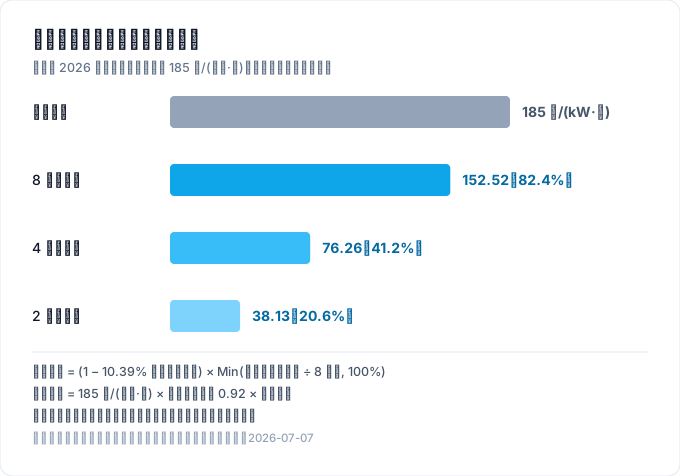
The national framework was set first. The Notice on Improving the Capacity Electricity-Price Mechanism on the Generation Side (NDRC Price [2026] No. 114), issued on 2026-01-30, proposes a capacity-electricity-price mechanism for grid-side independent new-type energy storage. At the provincial level, Qinghai's Reliable Capacity Compensation Mechanism on the Generation Side, issued on 2026-07-07, sets a unified capacity compensation standard of 185 yuan per kW-year for 2026, valid through 2031-07-06. The nominal standard is not the amount received; it passes through three conversions:
Reliable-capacity factor = (1 − overall auxiliary-power consumption rate) × Min(full-power discharge duration ÷ duration of the system net-load peak, 100%)
The overall auxiliary-power consumption rate for new-type storage is taken as 10.39%. The duration of the system net-load peak is taken as 8 hours, corresponding to the top 3% of net-load peak periods over the past three years. The capacity supply-demand factor is 0.92 (total system capacity requirement of 20,920 MW ÷ total reliable capacity of 22,788 MW). Converted annual compensation per installed unit is 185 × 0.92 × factor:
| Full-power discharge duration | Reliable-capacity factor | Converted value (yuan/kW·year) | Share of nominal standard |
|---|---|---|---|
| 2 hours | 0.224025 | 38.13 | 20.6% |
| 4 hours | 0.448050 | 76.26 | 41.2% |
| 8 hours | 0.896100 | 152.52 | 82.4% |
Take a 100 MW installation: a 4-hour system has a recognized reliable capacity of 44.805 MW and annual capacity charges of about 7.6258 million yuan; a 2-hour system has a recognized reliable capacity of 22.402 MW and annual charges of about 3.8129 million yuan. The same nominal standard differs by exactly four times after conversion; under this calculation, long-duration systems benefit.
The second mismatch is who the mechanism belongs to. The Qinghai document says that it applies to "public coal-fired generation, gas-fired generation, solar-thermal generation not included in the sustainable-development price settlement mechanism and not receiving renewable-energy subsidies, and grid-side independent new-type energy-storage power stations that serve safe operation of the power system and have not participated in mandatory co-located storage." Behind-the-meter storage built at a company's own site and connected to its internal distribution system is not included. More importantly, the cost-sharing provision says that capacity charges are apportioned among all industrial and commercial users in the province according to their monthly electricity consumption. Industrial and commercial users are the payers under this mechanism, not the recipients. Including it in a behind-the-meter storage revenue model reverses the direction. Shaanxi's threshold is 165 yuan per kW-year, with a six-hour conversion basis and a provisional three-year term. Local parameters differ, but the allocation logic is the same: this is a generation-side mechanism.
Can storage installed in a company's own distribution system participate directly in the market?
Not directly. This step is often skipped in revenue estimates, but it determines whether the algorithms above apply at all. A reply from the Anyang Municipal Development and Reform Commission to a municipal people's congress proposal on 2026-06-30 states specifically:
All user-side storage currently in operation in our city is for the company's own use, connected to the company's internal low-voltage distribution system. It cannot be directly connected to the public grid and can only consume electricity internally.
An interconnection point inside the company's own distribution system is not an interconnection point for an independent market participant. The route described in the document is to commission a virtual power plant or load aggregator to integrate, control, and conduct proxy transactions, responding indirectly to grid dispatch.
The standards system draws the same boundary. The applicable national standard differs depending on whether the interconnection point is on the public-grid side or the user's internal-grid side, even when the storage is electrochemical:
| Standard | Scope stated in the standard |
|---|---|
| GB/T 36547-2024, Technical Regulations for Connecting Electrochemical Energy Storage Power Stations to the Grid | Energy-storage power stations connected to the public grid through a voltage level of 10(6) kV or above |
| GB/T 44113-2024, Specification for Grid-Connection Management of User-Side Electrochemical Energy Storage Systems | Energy-storage systems connected to the internal grid of an electricity user |
| GB/T 43526-2023, Technical Regulations for Connecting User-Side Electrochemical Energy Storage Systems to Distribution Networks | Energy-storage systems connected to the user's distribution network through a voltage level of 220 V or above |
| GB/T 44114-2024, Operating and Control Specification for Connecting Electrochemical Energy Storage Systems to Low-Voltage Distribution Networks | Operating control of energy-storage systems connected to a distribution network below 10(6) kV |
Reading the four scopes side by side provides more information than any document alone: "public grid" and "user distribution network" are two different interconnection bases, and user-side storage is placed in the latter category by the standards themselves. That is its position in the current system—an internal load-side resource, not a market participant.
The practical implication is clear. Take a 1,250 kVA transformer with a 0.4 kV low-voltage side and connect 500 kW / 1 MWh of storage to this bus. It can only shave peaks and fill valleys within this distribution network. To earn revenue from the spot market, three issues must first be solved—separate metering (without separately metered energy, it cannot be aggregated or dispatched), communications and interfaces that can be monitored and dispatched (one condition for storage to become independent storage), and the possibility of reserving a separate interconnection point. Retrofitting the third item later costs far more than getting it right once.
Why may the "charge at night and discharge during the day" configuration stop working?
Under fixed time-of-use electricity pricing, the valley period was late at night. That is why almost all commercial and industrial storage was designed to charge at night and discharge during the day. As the share of installed photovoltaic generation rises, the lowest-price period has moved to noon. A 2026 trading notice from the Shaanxi Electricity Trading Center says that "the lowest electricity price will mainly occur during the noon period of strong photovoltaic output" and asks market-oriented users to adjust their electricity-use habits. The Hebei Southern Network requires medium- and long-term contracts to pass through the characteristics of the monthly time-of-use price curve in the real-time spot market to retail users. The location of the valley period has changed, so the charge/discharge schedule must shift as a whole: from "night valley—morning peak / midday flat—evening peak" to "midday valley—evening peak / night valley—next-morning peak."
One consequence follows directly. If the lowest-price window is at midday and the available low-cost duration is much shorter than the continuous night valley, the time required to fully charge at rated power may exceed the low-price window—installed capacity has not decreased, but the energy actually cycled each day can be lower than designed. More capacity does not mean more energy can be discharged.
What should change in the investment decision after recalculating the economics?
Three changes, in order:
- Calculate the threshold before discussing the spread. Substitute the project's own investment cost, cycle life, and efficiency into the formula above to obtain its project-specific break-even spread, then compare it with the historical price distribution in each local period instead of directly reusing someone else's threshold.
- Keep revenue streams in separate ledgers, and do not include capacity compensation. Spot spreads, demand response, and ancillary services may be combined, but they have different requirements for response speed, metering, and communications. Capacity compensation is a generation-side mechanism; behind-the-meter storage is not on the list.
- Move metering and dispatch conditions into the design stage. A separate metering point, a communications channel that supports remote dispatch, and a reserved location for a separate interconnection point determine whether storage can later be aggregated and whether it can qualify as independent storage.
When does this calculation fail? If the spot-market spread at the project location remains below the local break-even threshold, or if the company's own load curve does not permit charging during low-price periods, the conclusion does not hold. The value of storage should then be reassessed through demand management and supply reliability rather than arbitrage.
Questions that still have no answer
- The distribution of intraday spot-market spreads—mean, median, and the share of days below a given threshold. No province appears to publish data at a granularity suitable for investment calculations. This article can give a threshold, but not "how many days per year clear it."
- The revenue-sharing ratio when behind-the-meter storage commissions an aggregator to conduct proxy transactions. Local rules are not uniform. The Henan reply explicitly says that the province has not yet issued guidance, recognition standards, or operating rules for converting behind-the-meter storage into independent storage.
- Future capacity-compensation standards. Qinghai's current standard is fixed only through 2026; subsequent parameters will be announced annually. This article's conversion uses the 2026 parameters.
- The duration distribution of the midday low-price window. No cross-provincial public statistics were found.
Other common questions
Are industrial and commercial users that do not participate directly in the market unaffected? No. Users supplied through grid-company proxy purchases still follow government-defined peak/off-peak periods and fluctuation ratios, but the Opinions on Improving the National Unified Electricity-Market System (State Council General Office [2026] No. 4) proposes gradually reducing the scale of proxy purchases and encouraging users at 10 kV and above to participate directly in the electricity market—the user's status will change, but the timetable is not set by the enterprise itself.
Will capacity compensation eventually extend to behind-the-meter storage? Document No. 114 calls for the compensation scope to be expanded gradually "in light of electricity-market development and electricity-price marketization reform." The direction is clear, but current documents do not include behind-the-meter storage and provide no timetable. Whether it can enter as an aggregating entity depends on local rules.
References
- National Development and Reform Commission and National Energy Administration, Notice on Issuing the Basic Rules for the Medium- and Long-Term Electricity Market (NDRC Energy Regulation [2025] No. 1656), 2025-12-17. https://zfxxgk.ndrc.gov.cn/web/iteminfo.jsp?id=20581 (accessed 2026-09-17)
- National Development and Reform Commission and National Energy Administration, Notice on Improving the Capacity Electricity-Price Mechanism on the Generation Side (NDRC Price [2026] No. 114), 2026-01-30. https://www.ndrc.gov.cn/xxgk/zcfb/tz/202601/t20260130_1403524_ext.html (accessed 2026-09-17)
- Chinese Government website, State Council General Office, Opinions on Improving the National Unified Electricity-Market System (State Council General Office [2026] No. 4), 2026-02-11. https://www.gov.cn/zhengce/content/202602/content_7057744.htm (accessed 2026-09-17)
- Qinghai Provincial Development and Reform Commission, Notice on Issuing the Reliable Capacity Compensation Mechanism on the Generation Side of Qinghai Province, 2026-07-07. http://fgw.qinghai.gov.cn/xwzx/tzgg/202607/t20260707_92143.html (accessed 2026-09-17)
- Anyang Municipal Development and Reform Commission, Reply to Proposal No. 47 of the Fourth Session of the 15th Municipal People's Congress, 2026-06-30. https://fgw.anyang.gov.cn/2026/08-25/2518243.html (accessed 2026-09-17)
- National standard Technical Regulations for Connecting Electrochemical Energy Storage Power Stations to the Grid (GB/T 36547-2024), published 2024-05-28, implemented 2024-12-01, replacing GB/T 36547-2018. The standard is cited in the National Energy Administration's China New-Type Energy Storage Development Report (2025). https://www.nea.gov.cn/20250731/1d40d09f75714280a9218d5bea178fbd/202507311d40d09f75714280a9218d5bea178fbd_453d9a0609da1d4456a8b12d843bd256cf.pdf (accessed 2026-09-17)
- National standard Technical Regulations for Connecting User-Side Electrochemical Energy Storage Systems to Distribution Networks (GB/T 43526-2023), published 2023-12-28, implemented 2024-07-01. https://std.samr.gov.cn/gb/search/gbDetailed?mode=p&id=YxuxQp4Wu1o%3D (accessed 2026-09-17)
- National standard Specification for Grid-Connection Management of User-Side Electrochemical Energy Storage Systems (GB/T 44113-2024), published 2024-05-28, implemented 2024-12-01. https://std.samr.gov.cn/gb/search/gbDetailed?id=m7Yscm65erI%3D&mode=p (accessed 2026-09-17)
- National standard Operating and Control Specification for Connecting Electrochemical Energy Storage Systems to Low-Voltage Distribution Networks (GB/T 44114-2024), published 2024-05-28, implemented 2024-12-01. https://std.samr.gov.cn/gb/search/gbDetailed?id=19B8508AED554286E06397BE0A0A616D (accessed 2026-09-17)
- Northwest China Energy Regulatory Bureau of the National Energy Administration, Nine Locations Nationwide Cancel Fixed Time-of-Use Electricity Pricing (originally published by Yicai), 2026-02-14. https://xbj.nea.gov.cn/dtyw/hyxx/202602/t20260214_296030.html (accessed 2026-09-17)
- China Energy Storage Network, Shaanxi Independent-Storage Capacity Electricity Price 165 yuan/kW/year; Qinghai Capacity Compensation 185 yuan/kW·year, 2026-07. https://www.escn.com.cn/news/show-2260937.html (accessed 2026-09-17)
- China Energy News, Multiple Locations Cancel Fixed Time-of-Use Electricity Pricing; Storage Says Goodbye to the "Easy Money" Era (reproduced by China Industrial News Network), 2026. https://www.cinic.org.cn/xw/schj/1634299.html (accessed 2026-09-17)
- Energy-storage industry material, Do the New Policies "Unbundle" Time-of-Use Electricity Pricing? Sichuan Storage (source of the "peak-to-valley spread must exceed 0.7 yuan/kWh" threshold). https://chuneng.in-en.com/html/chunengy-50464.shtml (accessed 2026-09-17)
- China Commercial Energy Storage System Market Analysis (basis for system unit-price range and cycle-life assumptions). https://www.indexbox.io/store/china-commercial-energy-storage-system-market-analysis-forecast-size-trends-and-insights (accessed 2026-09-17)
- Haitai New Energy, Economic Calculation and Investment-Return Analysis for Commercial and Industrial User-Side Energy-Storage Power Stations (basis for EPC cost and O&M rate). http://xmhtxn.com/news/14868.html (accessed 2026-09-17)